





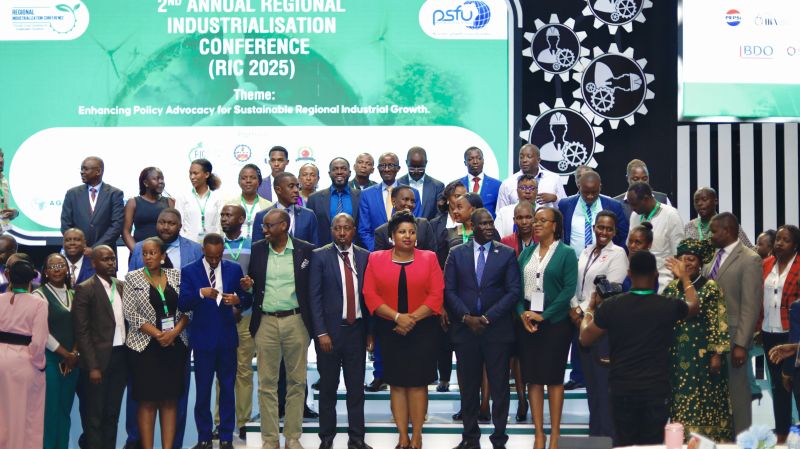
As policymakers and industry leaders converged at the 2nd Annual Regional Industrialisation Conference in Kampala, a critical conversation took centre stage: the relentless battle against illicit trade. The conference, themed “Enhancing policy advocacy for sustainable regional industrial growth,” shone a spotlight on how counterfeit goods, smuggling, and substandard products are not just a regulatory headache but a profound threat to industrial growth, market integrity, and public safety.
Speaking at the conference, Eng. James Kasigwa, the Executive Director, UNBS, noted that while public sector regulators like the Uganda National Bureau of Standards (UNBS) are at the forefront of this fight, a powerful new message is emerging: to truly win this war, Uganda must move beyond regulation and build a comprehensive National Quality Culture.
According to Eng. Kasigwa, the fight against illicit trade is a complex one, fueled by several factors, some of which include:
- Consumer Demand: a persistent demand for cheaper alternatives, often at the expense of quality and safety.
- Economic Pressures: Tax evasion and low uptake of standards by Micro, Small and Medium Enterprises (MSMEs), which comprise the bulk of Uganda’s economy.
- Systemic Weaknesses: Weak border controls, corruption, and a lack of institutional capacity.
- Globalisation and Technology: The very tools that facilitate legitimate trade can also be exploited by illicit networks.
Eng. Kasigwa revealed that the UNBS has been fighting illicit trade on multiple fronts, with significant achievements in the past year alone. He explained that over the years, UNBS has developed more than 4,800 standards, issued certification permits to over 5,700 products in FY2024/25 (including 1,772 for MSMEs), and reported a 65% market compliance rate for goods in the Ugandan market. However, he observed that even with these efforts, the challenge persists.
The solution, according to Kasiwga, lies in a dual-pronged approach that enlists the private sector and the general public as active participants.
Public sector regulation, while essential, cannot be everywhere at once. This is where industry self-regulation becomes critical. Kasigwa noted that enterprises must commit to a culture of producing quality goods and services not because of regulatory fear, but because of a shared responsibility to the consumer and the industry’s reputation. This commitment, according to him, includes:
He called upon businesses to voluntarily embrace the standards set by UNBS, seeing them not as a barrier but as a roadmap to quality, market access, and consumer trust. He urged all stakeholders to commit to fair and transparent practices that differentiate them from illicit traders.
The Power of the Consumer
Kasigwa, however, emphasised that the fight against illicit trade is also a consumer responsibility. He called for the empowerment of consumers to demand and buy only good-quality and certified products. “At UNBS, we are now focusing on growing quality MSMEs by hand-holding them to meet standards requirements,” he stated, adding, “But we are also encouraging all consumers to look out for the UNBS quality mark when shopping. It’s the only way to guarantee the safety of products bought.”
He stressed that the UNBS quality mark is not just a stamp but a promise of safety, quality, and compliance, noting that by consciously choosing certified products, consumers can directly support legitimate businesses and deny the illicit trade ecosystem its most vital resource, which is demand.
Kasigwa’s call to action is a holistic one. The fight against illicit trade is not the sole burden of government regulators. It requires a unified front involving the industry, consumers, and the public. He explained that building a National Quality Culture means:
- Empowering MSMEs by providing the necessary support for small businesses to produce compliant products, the way UNBS is already doing.
- Educating Consumers by raising awareness so consumers can make informed choices and become a powerful force for market integrity.
- Promoting Collaboration by fostering continued cooperation among all stakeholders, including the Private Sector Foundation Uganda (PSFU), the Uganda Manufacturers Association (UMA), AGRA, and the Uganda Industrial Research Institute (UIRI), who were all partners in this conference.
He concluded by pointing out that by embracing this new direction, Uganda can build a resilient, ethical, and competitive market that not only combats illicit trade but also sets a new standard for sustainable regional industrial growth.