



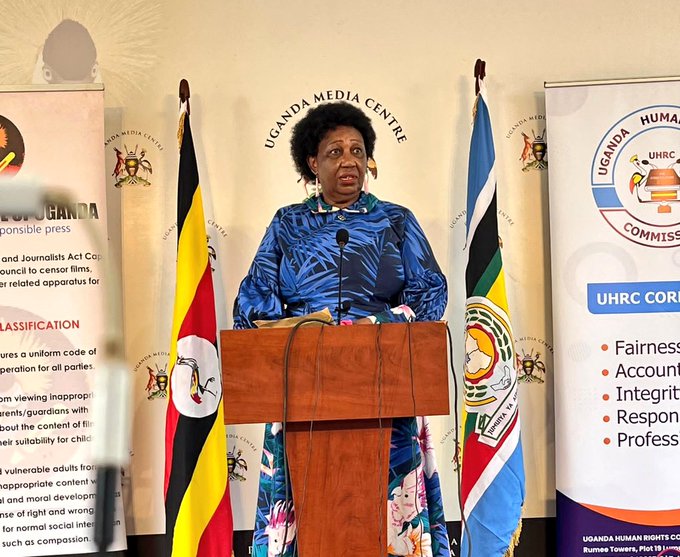

The Uganda Human Rights Commission (UHRC) has officially endorsed the outcome of the 2026 presidential elections, describing the polls as free, fair and credible.
Releasing the Commission’s preliminary statement on Sunday, UHRC Chairperson Mariam Wangadya said the electoral environment and security deployment enabled Ugandans to exercise their right to vote in a largely peaceful atmosphere.
“The election climate and security deployment fostered a peaceful electoral process that was largely free and fair, allowing people to exercise their right to vote peacefully, with limited violent incidents reported,” Wangadya said.
She added that the credibility of the process was reinforced by proper documentation of results at polling stations.
“The results announced from various polling stations were properly documented, and there is no concrete reason why the UHRC should not endorse the elections,” she said.
However, UHRC raised concerns over human rights violations, including an internet shutdown, isolated incidents of violence and failures in biometric voter verification.
Observers, Deployment and Scope
The UHRC congratulated the Electoral Commission, all candidates and the people of Uganda for the successful conclusion of the elections, and commended the 1,655 international, regional and national election observers accredited to monitor the polls.
The Commission said it deployed 121 observers drawn from its commissioners and staff to 990 polling stations across 78 of Uganda’s 146 districts, operating through its 12 regional offices.
However, the UHRC did not observe parliamentary elections in Kibanda North Constituency in Kiryandongo District and Ibanda Municipality, after the Electoral Commission suspended polling due to mismatches between candidates’ names and symbols on ballot papers.
Polling Day Logistics and Turnout
According to the Commission, polling materials were delivered on time at the majority of polling stations.
“However, delays were recorded in Kampala, Wakiso and Mukono, with some materials arriving as late as 10:00 a.m., forcing voting to begin between 9:00 a.m. and 11:30 a.m. at several stations,” Wangadya said.
Despite the delays, voters arrived early and remained calm.
“Voters arrived as early as 6:30 a.m. and remained patient and orderly,” she noted.
On voter turnout, the UHRC cited Electoral Commission figures showing that 11,366,201 voters cast ballots out of 21,649,068 registered voters, representing a 52.50 per cent turnout.
This marked a decline of 6.85 percentage points compared to the 59.35 per cent turnout recorded in the 2021 general elections.
Higher participation was recorded in rural areas, while Kampala and Wakiso registered notably low turnout.
Biometric Verification Challenges
The Commission raised serious concerns about the performance of biometric voter verification kits, which were introduced to enhance transparency.
The UHRC observed that the kits functioned effectively at only a limited number of polling stations, including parts of Kyankwanzi, Bulisa, Bunyangabu, Karenga, Kaabong, Moroto, Napak, Nakapiripirit, and Rwentojo Ward in Mbarara District.
In Yumbe and Wakiso, some polling stations did not receive the kits at all.
At around 9:30 a.m., the Chairperson of the Electoral Commission directed polling officials to revert to the manual National Voters’ Register where the biometric systems had failed.
While the UHRC commended the Commission for allowing voting to continue and extending polling time from 4:00 p.m. to 5:00 p.m., it criticised the timing of the communication.
“The guidance was issued only minutes before the official closing time, meaning some presiding officers did not receive it in time,” Wangadya said.
Nevertheless, all registered voters who were present at polling stations were allowed to vote.
Accessibility, Security and Vote Counting
The Commission reported that most polling stations were located in accessible areas, including schools, churches and open grounds, enabling participation by older persons, persons with disabilities and expectant mothers.
However, in Moroto and Nakapiripirit, some voters were forced to walk long distances from mountainous areas.
Security on polling day remained largely calm nationwide.
“Police patrols were observed around polling stations without interfering in the voting process,” Wangadya said.
While most officers were unarmed or lightly equipped, some in parts of Kampala, Sembabule and Mbarara were seen carrying firearms.
Each polling station was guarded by at least two polling constables.
Vote counting and tallying were conducted in line with Electoral Commission guidelines, in the presence of candidates’ agents, observers and voters.
Although most polling stations closed at 5:00 p.m., counting extended beyond 8:00 p.m. in some areas, with agents receiving copies of the Declaration of Results forms.
Security Deployment
Wangadya said the heavy security deployment helped instill confidence among voters, noting that police and military presence made citizens feel safe.
“We were assured of security. We were assured of safety,” she said.
She added that her own observation at a polling station showed security officers assisting voters.
“By the way, again where I voted from the policemen and women I saw there, I saw them helping these voters,” she said.
On allegations of the National Unity Platform Presidential Candidate’s home under siege, she said the commission had dispatched a team of officers to go and interface with Robert Kyagulanyi, alias Bobi Wine and report back.
Human Rights Concerns
Despite endorsing the election outcome, the UHRC highlighted several human rights concerns.
These included the temporary suspension of public internet access imposed by the Uganda Communications Commission on January 13, 2026, which affected approximately 17 million internet subscribers.
The Commission said the shutdown limited access to information and freedoms of expression and association, and disrupted mobile money services, particularly in rural areas.
However, she noted that the need to close down the internet could have been greater than individual interferences, further asking anyone affected to file a complaint where need be.
“The losses are regrettable and if the suspension of internet was informed by the public good, again let the public good prevail .But we cannot, individual business people who suffered and seek compensation, they can file claims with the challenges within the election period. We were assured of security. We were assured of safety,” she said.
Although polling was generally peaceful, incidents of violence were reported in Lwemiyaga, Bukedea, Mukono, Butambala, Mityana, Kampala, Kayunga, Luweero and Wakiso.
Media reports cited seven deaths, three gunshot injuries and 25 arrests in Butambala and Kalungu.
Invalid Votes and Party Agents
On invalid votes, the UHRC cited Electoral Commission figures showing 11,090,848 valid votes and 275,353 invalid votes.
The Commission said many invalid ballots resulted from incorrect marking or failure to mark, noting that the number remains high compared to the 393,500 invalid votes recorded in 2021.
The UHRC also observed disparities in party agent representation, with NRM and NUP agents present at most polling stations, while DP, ANT and FDC had limited presence.
Election Results
Wangadya dismissed claims that the election results were not authentic, saying the commission had no reason to doubt the declared outcome.
“I do not have any reason to doubt the authenticity of those results. What is very important is that every registered voter who turned up to vote voted. No one was disenfranchised, at least not deliberately. To me, that cannot affect the fairness of an election. Yes, Ugandans got a free and fair election,” she said.
She added that candidates who doubt the results should pursue legal channels.
“Any candidate who doubts the authenticity of those results can petition court to have them verified as provided by the law,” she said.
Recommendations and Final Outcome
In its preliminary recommendations, the Commission urged the Electoral Commission to:
Conduct comprehensive testing of electoral technologies before polling
Allocate a mandatory percentage of election financing to voter education
Allow candidates’ agents to verify voters using the manual register where digital systems fail
Despite the challenges, the UHRC concluded that Ugandans were able to vote in a generally peaceful and secure environment.
Incumbent President Yoweri Kaguta Museveni, the NRM candidate, secured 71.6 per cent of the vote, defeating seven other contenders, while his closest rival, Robert Kyagulanyi of the National Unity Platform, polled 24.5 per cent in the January 15, 2026 elections.