



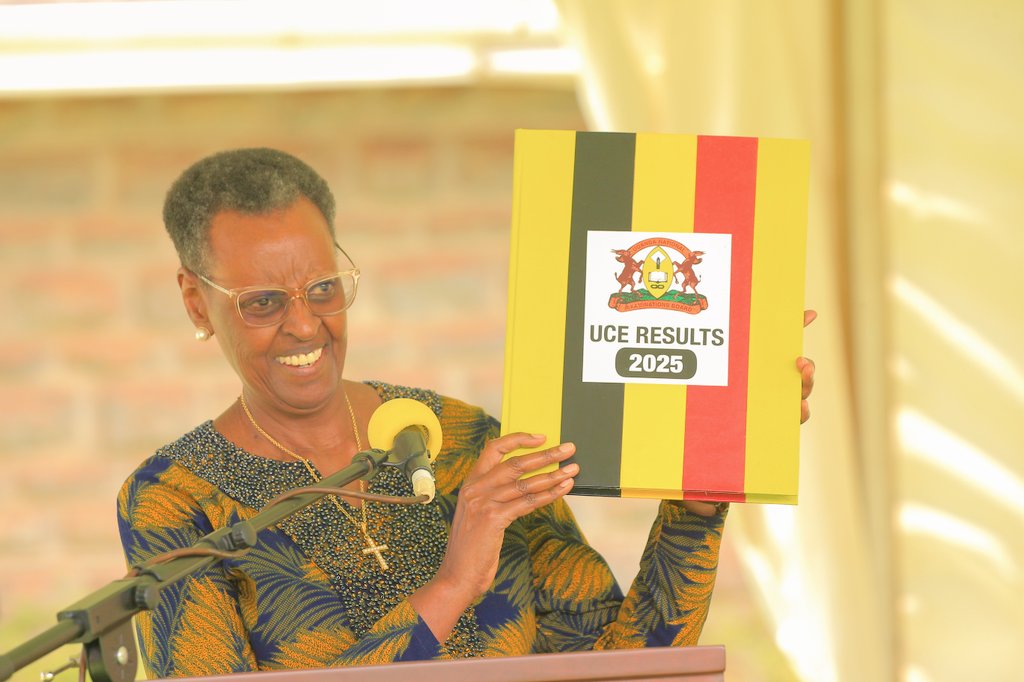

The Uganda National Examinations Board (UNEB) has announced that an overwhelming 99 percent of candidates who sat for the 2025 Uganda Certificate of Education (UCE) examinations have successfully qualified for their certificates. This remarkable achievement represents a continuation of a trend of improved student participation and performance, under the Competency-Based Curriculum (CBC).
A total of 432,163 candidates registered for the examinations across 3,975 centres, up from 359,417 in 2024, marking a 20.2 percent increase. Of these, 204,292 (47.3%) were male, while 227,871 (52.7%) were female. USE beneficiaries comprised 154,642 candidates (35.8%), and non-USE candidates accounted for 277,521 (64.2%). Attendance rates were exceptionally high, with 429,949 candidates (99.5%) present, leaving only 2,214 absent (0.5%).
Performance by Grades and Gender
Under the CBC framework, UNEB combines 20% Continuous Assessment with 80% End-of-Cycle Examination scores to produce holistic grades ranging from A to E. Among the top performers, male candidates outperformed their female counterparts in Geography, Mathematics, Agriculture, Physics, Chemistry, Biology, History, and Political Education. In contrast, female students achieved higher grades in English Language and Christian Religious Education.
Specific highlights included: Geography Grade A: Boys 8%, Girls 3.1%, Mathematics Grade A: Boys 1.9%, Girls 1.1%, Physics Grade A: Boys 1%, Girls 0.6% and Chemistry Grade A: Boys 0.9%, Girls 0.8%.
According to UNEB Executive Director Dan Odongo, these differences are partly explained by the curriculum’s emphasis on connecting theoretical knowledge to real-life scenarios.
He explained, “Boys seem to perform better in subjects requiring numerical, scientific, or analytical reasoning, while girls demonstrate higher achievement in languages and subjects involving comprehension and interpretation, such as English and CRE.”

Despite these distinctions, the overall rate of candidates failing to obtain a certificate dropped dramatically from 1.9% in 2024 to just 0.31% in 2025, showing the overall effectiveness of the CBC in supporting learning and improving outcomes.
Among the registered students, 708 were Special Needs Education (SNE) candidates, including 342 males and 366 females. Breakdown by category included 27 blind, 116 low vision, 60 deaf, 90 dyslexic, 72 physically handicapped, and 343 with other disabilities such as sickle cell anaemia, epilepsy, or accident-related impairments. Attendance was near perfect, with only 4 absentees (0.6%), while 695 candidates (98.2%) passed, and 9 (1.8%) did not qualify. UNEB provided Braille papers, enlarged-print papers, sign language interpreters, additional support personnel, and an extra 45 minutes per paper, ensuring accessibility and fairness for all candidates.
Odongo further says that inmates at Uganda’s prison schools also performed exceptionally. At Luzira Upper Prison School, all 39 candidates who sat for the exams passed and qualified for certificates. At Mbarara Main Prison Inmates’ Secondary School, all 12 candidates passed. These successes highlight the inclusivity of the education system, ensuring even marginalized or incarcerated students can achieve academic recognition.

Examination Malpractice Remains Minimal
The UNEB ED explained that integrity of the examination was maintained, with only 63 cases of malpractice reported. These were primarily in Mathematics and practical papers in Physics, Chemistry, and Biology. UNEB noted that in most instances, candidates had been provided experimental results by teachers, which they simply copied, rather than conducting the investigations themselves.
“The design of the examination items does not easily lend itself to malpractice. Where external assistance occurred, the investigation designs did not correspond with recorded results, clearly indicating malpractice.” said Odongo.
Meanwhile Odongo says UNEB conducted a survey involving 36,546 candidates from 118 districts to assess the quality of the examinations. Key findings included:96.3% of candidates reported that the exam items were within the syllabus , 74.7% felt the allocated time was adequate, 88.2% found the questions clearly presented,4.7% found the examination easy, 66.4% fair, and 28.8% difficult
This feedback demonstrates that the CBC framework is both challenging and accessible, ensuring candidates are evaluated fairly.

Minister Janet Museveni’s Remarks
Education Minister Janet Museveni, who released the results, applauded UNEB for carrying out research on the impact of the CBC. She noted that interviews with teachers, headteachers, and learners from 171 secondary schools confirmed that the curriculum is positively transforming learning outcomes, fostering critical thinking, problem-solving, and real-life application skills. The Minister described the results as “encouraging, particularly in the sciences, where more candidates are achieving at least Grade D and above.”