



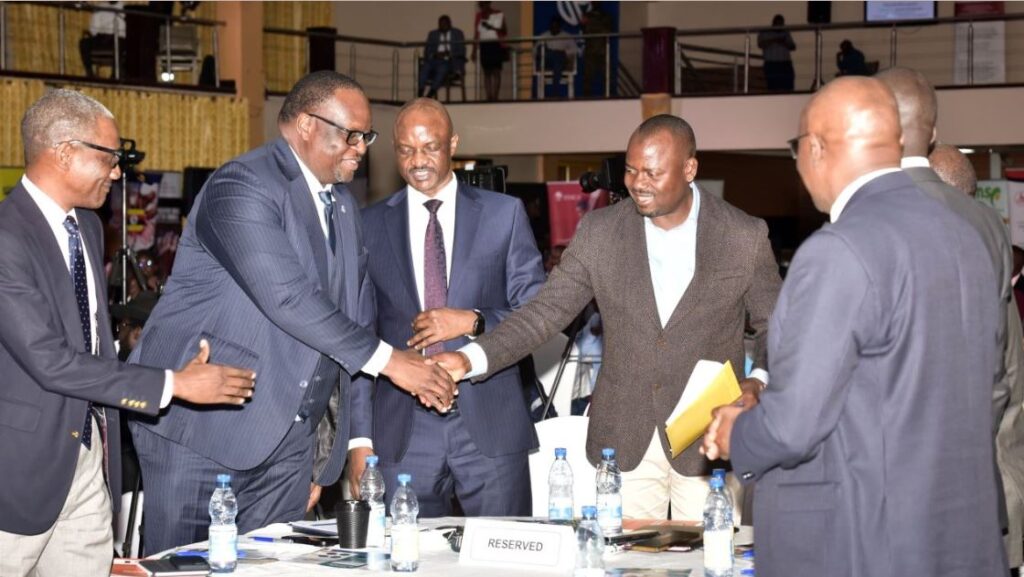

Stanbic Bank Uganda is solidifying its position as a key partner in Uganda’s economic transformation, anchoring its strategy on the deliberate empowerment of Women, Youth, and Farmers (WYF). This commitment was highlighted at the 3rd Annual National Microfinance and Savings Groups Conference held on Monday at Hotel Africana, in Kampala, where the bank’s leadership articulated a clear vision for sustainable and inclusive growth.
The Conference was officiated over by Hon. Haruna Kasolo, the State Minister for Microfinance, who was flanked Mr. Ramathan Ggoobi, the Permanent Secretary, Ministry of Finance.
In his keynote address on the “Private Sector’s Positive Impact Agenda for Women, Youth and Farmers,” Stanbic Bank Chief Executive Kenneth Mumba Kalifungwa emphasised that financial inclusion is not merely a service, but a “strategic responsibility” that must directly lead to empowerment and prosperity.
He noted that Stanbic Bank’s approach goes beyond traditional lending, integrating financial services with capacity building to achieve a broad economic impact. According to Mr. Kalifungwa, the core of this strategy lies in empowering the three most critical demographic groups for Uganda’s future: Women, Youth, and Farmers (WYF).
Mr. Kalifungwa stressed that “genuine financial inclusion must translate to empowerment, productivity, and long-term prosperity.” He underscored the bank’s focus on ensuring these groups can participate meaningfully in the formal economy.
He revealed that Stanbic Bank is actively involved in mobilising both financial and non-financial resources to facilitate growth, especially among Women, Youth and Farmers. This, he emphasised, includes building capacity and forming key partnerships that are essential for long-term sustainability.
Mr. Kalifungwa stressed that the bank’s initiatives are designed to achieve multiple, interconnected goals, key among those being: Expanding access to financial services, creating jobs, improving enterprise readiness, supporting climate adaptation and strengthening community resilience.
Demonstrating the seriousness of its mission, Mr. Kalifungwa divulged that Stanbic Bank had committed a substantial financial pledge of Shs1 trillion to empower Women, Youth and Farmers, aligning its capital mobilisation with its strategic agenda. “Stanbic is committing up to Shs1 trillion over the next four years through collaborative programmes that enable Ugandans to participate meaningfully in the economy and build generational wealth,” Mr. Kalifungwa said.
He explained that this significant investment highlights the bank’s role in filling the resource gap necessary for scaling up microfinance, savings group initiatives, and critical development programs.
By channeling resources specifically into programs targeting the WYF groups, Stanbic Bank aims to create a sustained, positive impact that extends beyond individual transactions to secure long-term national economic stability.
The bank’s attendance and keynote address, under the conference theme “Sustainable Financial Inclusion for Environmental, Economic and Social Impact,” position Stanbic as a leader in deploying private sector capital for public good, actively driving Uganda’s transition toward a more resilient and inclusive economy.