



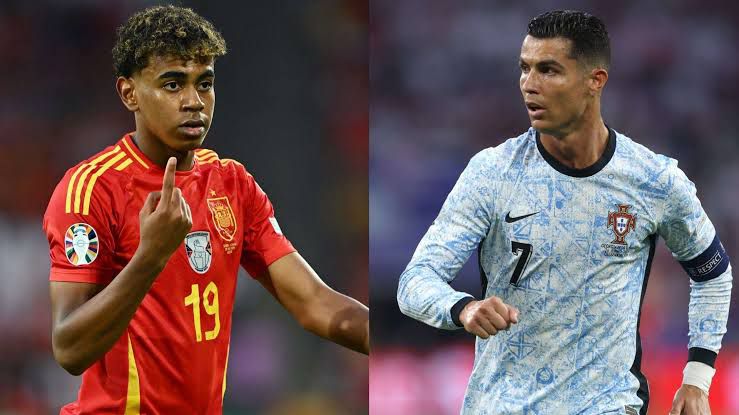

Cristiano Ronaldo and Lamine Yamal are separated by 23 years and more than 850 career goals, but on Sunday night in Munich, they will share the same pitch in what could be one of the more symbolically significant matches in recent international football, the UEFA Nations League final between Portugal and Spain.
The match represents more than the chance to win silverware. It stands, in part, as a quiet marker of a generational transition in football, a final that places one of the greatest players in history against one of its most promising talents.
Ronaldo, now 40, is set to play in his 231st international match for Portugal. He has scored 137 goals for his country, a record in men’s international football, and, despite his age, remains part of Portugal’s head coach Roberto Martínez’s plans. His semi-final winner against Germany demonstrated his continued importance, not just as a constant presence, but as a decisive one.
Martínez has maintained that Ronaldo’s place in the squad is “based on merit” and “not reputation,” and that he still plays “a unique role in high-pressure situations.” Internally, there is recognition that this could be his final competitive match for Portugal.
On the other side, Spain will likely start Lamine Yamal, aged only 17 years and 41 days on the night of the final. The Barcelona winger has quickly become central to Luis de la Fuente’s attacking setup, having contributed two goals and an assist in Spain’s dramatic 5–4 win over France in the semi-finals. This season, Yamal made 53 appearances for Barcelona across all competitions, registering 18 goal involvements.
The contrast between the two players is clear, but within the Spain camp, the focus has not been on the narrative. Yamal, speaking in the build-up to the final, described Ronaldo as “a legend” and said, “I’ve grown up watching him, and to play against him is a special moment. But I’m focused on my job.”
Spain’s technical staff view Yamal as a long-term cornerstone of the national team. Behind the scenes, he is described as mature, tactically aware, and unfazed by pressure which was demonstrated when he calmly put a penalty past French keeper, Mike Maignan in the high intensity semi final. The Spanish FA (RFEF) are aware of the external attention but are attempting to manage his exposure carefully, both in terms of media and on-pitch workload.
Portugal, meanwhile, continue to integrate younger profiles, João Neves, António Silva, Gonçalo Inácio, while balancing the experience of Ronaldo, Pepe (41), and Rúben Neves. Internally, the Nations League is being treated seriously. A second title in the competition, after their inaugural win in 2019, would cement this generation’s place in the country’s football history.
While comparisons have been made between Yamal and other emerging players like Jude Bellingham and Jamal Musiala, his current trajectory is unique in Spanish football history, surpassing even the early breakthroughs of Gavi and Pedri.
For Ronaldo, this is potentially a final public chapter. For Yamal, it’s one of the first. Regardless of the outcome, Sunday’s final is likely to be remembered less for the result and more for the subtle significance of two players, one at the peak of his legacy, the other at the beginning of his story, intersecting briefly, at the highest level. We get to see the symbolic button passed on in what is destined to be a high stakes UEFA Nations League Final.