



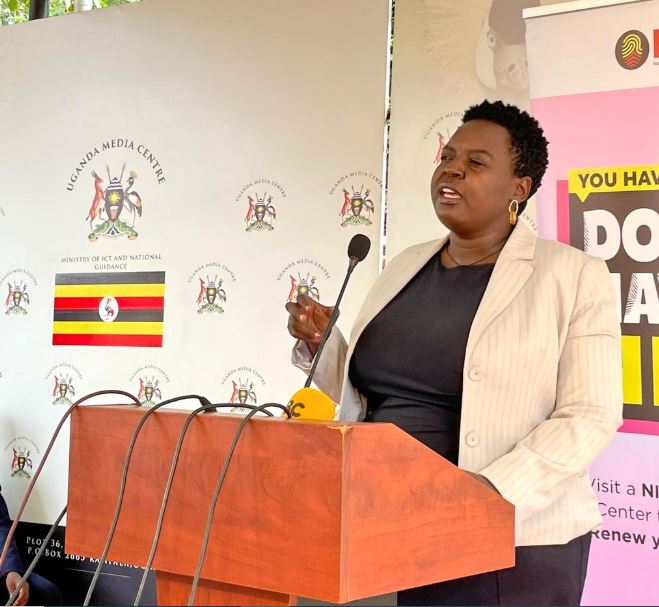

Uganda is at a crucial juncture in its national identity card renewal exercise. While over 5.3 million citizens have already renewed their National IDs, the National Identification and Registration Authority (NIRA) today issued a pressing call for accelerated action.
During a press briefing held at the Police Headquarters, Naguru, Claire Ollama, the Buikwe District Registrar, commended the impressive turnout, but warned that the current pace risks missing the critical six-month deadline. “Ugandans have spoken with their feet, over 5.3 million of you have already shown up to renew your National IDs. That’s no small feat. Asante sana,” Ms. Claire said.
However, she quickly highlighted the looming challenge saying: “If we continue at this pace of around 840,000 renewals per week, we’ll cross the finish line in about 9 months. Yet the race we signed up for is a 6-month sprint.” This disparity, according to Ollama, means communities must rally, parishes mobilise, and individuals show up early, as “every week matters, and every ID counts. The faster we go, the sooner Uganda gets the full benefit of a secure, inclusive, and modern ID system,” she emphasised.
Identity from Infancy
According to Ollama, NIRA is also carrying out universal registration, starting from infancy, which she said is not just an administrative task but a fundamental imperative for national integrity, protection, and justice.
School-Centric Registration Days
To ensure no child is left behind, NIRA announced a groundbreaking collaboration with the Ministry of Education and Sports to designate School-Centric Registration Days. On these specific dates, Ollama said, NIRA will dedicate its full operational capacity to registering every child in school. Forms will be readily available at schools or can be proactively collected from NIRA offices.
Ollama strongly urged to accurately fill out Form 3 or empower teachers with the necessary details for their children to be registered.
Inheritance Requires Identity
Ollama spoke plainly about this, saying: “Too many Ugandans are sitting on family land or assets legally registered in the names of their parents or grandparents. When the time comes to claim, transfer, or sell, one major obstacle arises: lack of identification.” She stressed that a land title without a matching National Identification Number (NIN) is a “locked gate.”
Without proof of identity, Ugandans cannot inherit their family’s legacy, and critically, without a NIN, children cannot inherit from their parents. Early registration, she highlighted, is not just a record but legal empowerment.
Misuse of Identity Cards
NIRA also raised a serious warning about the increasing risk of identity misuse. Many Ugandans, Ollama noted, unknowingly endanger themselves by lending out their identity cards to others to open bank accounts, purchase land, run businesses, hide assets, or avoid authorities.
She invoked the wisdom of Paul Kafeero’s song “Tusuza Emyoyo,” urging caution in such dealings. “When problems arise, it is your name that the law will hold accountable. Protect your name as your first asset,” she warned.
Change of Particulars Goes Live
Addressing a long-standing demand from the public, NIRA announced that the eagerly awaited Change of Particulars (COP) service will officially launch on July 21, 2025. This service, Ollama revealed, caters to Ugandans who missed the renewal window due to personal changes or administrative oversights.
She said a fee of Shs200,000 will apply to all changes not caused by NIRA. Full guidance and details will be available on the NIRA website at www.nira.go.ug.
Combating Corruption and Misinformation
Ollama reiterated NIRA’s zero-tolerance stance on corruption and misinformation, particularly regarding charges for its services. She explicitly stated that preregistration is optional and that NIRA services are FREE of charge.
She advised citizens who cannot preregister to visit a NIRA station with their ID card and a printed form.
“If forms are out of stock at the station, they can be downloaded from NIRA’s official website. Do not pay for forms, do not pay for favours, and let no one attach a price tag to a public service,” she emphasised.