



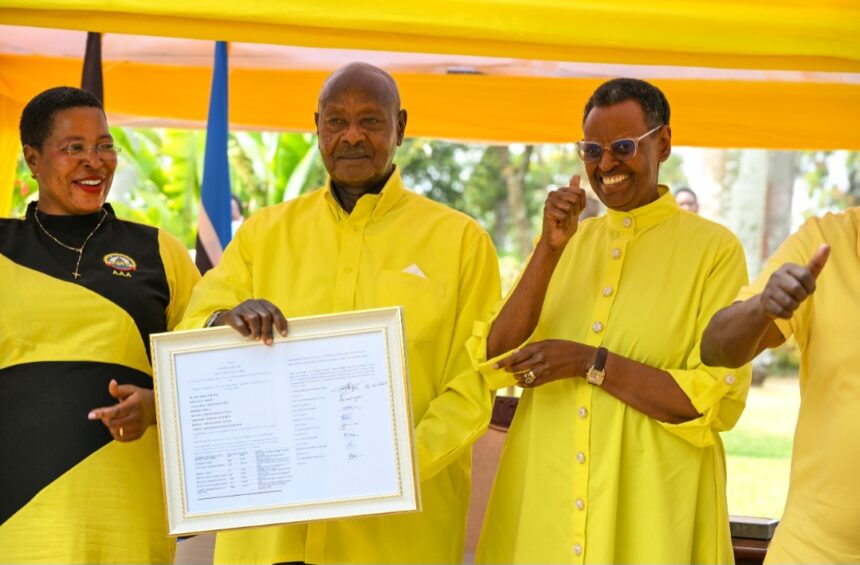

President Yoweri Kaguta Museveni over the weekend pulled a landslide victory against all seven of his opponents in the Presidential polls, securing a 71 percent victory in the January 15, 2026 elections..
The incumbent President NRM candidate, beat his rivals by a significant margin with 7,946,772 votes while his closest rival, Robert Kyagulanyi of the National Unity Platform, polled 24.5 per cent with 2,741,238 , winning him by 5,205,534 votes, in an election that saw 11,366, 201, 52.5 percent registered voters casting their ballots.
While addressing NRM leaders and supporters from his Rwakitura residence on Sunday, the President said Uganda’s opposition parties were spared an overwhelming defeat only because more than 10 million National Resistance Movement supporters did not turn up to vote, describing the election outcome as a partial test of NRM strength rather than a true reflection of its national support.
Museveni said the ruling party currently has 21 million registered members, of whom 18 million are of voting age, but only eight million cast ballots.
“The opposition were lucky because 10 million of my people did not turn up. They would have been embarrassed badly. We got eight million votes, but remember, when we reviewed our membership on the 6th of May, we had 21 million members and 18 million of them are voters,” Museveni said.
He stressed that the turnout gap was largely internal and not an opposition gain.
“Many of those who did not turn up are our members. Ten million of them did not turn up, so we must find out why. Why the ten million?” he said.
Museveni said the election should therefore be understood as a warning signal rather than a setback.
“It is a good test of the strength of the NRM, but it is not all the strength. If all the strength of the NRM turned up, there would be no opposition in Uganda,” he said.
The President said the ruling party is gradually regaining the ideological strength it enjoyed during the 1996 elections, when opposition messaging failed to resonate with the electorate.
“If you remember the elections of 1996, people were not willing to listen to any story from the opposition. They said, ‘Please, please, don’t disturb us.’ It had no impact in many parts of the country,” Museveni said.
He attributed that dominance to the NRM’s success in addressing Uganda’s most urgent needs at the time.
“The major needs were number one, a disciplined army which would not kill people, no extrajudicial killings. People were very, very happy with that,” he said.
Museveni also noted the elimination of sectarianism, infrastructure rehabilitation, and the restoration of basic commodities as pillars of early NRM legitimacy.
“People said the NRM had removed sectarianism. They were beginning to see that rehabilitation was coming. We had sorted the issue of shortages. People were united,” he said.
According to Museveni, that atmosphere of unity is re-emerging.
“When I was campaigning, I could see that the atmosphere of maximum unity is coming back now,” he said.
Museveni said peace remains the most powerful political currency in Uganda, particularly in regions that experienced prolonged conflict.
“In northern Uganda, in West Nile, in parts of eastern Uganda, people say, ‘What are you talking about? You want to bring war again? No,’” he said.
He said the population’s rejection of instability has weakened violent political mobilisation.
The President credited the Parish Development Model (PDM) and skilling hubs with restoring hope, particularly among young people.
“PDM has given people hope that we can get rid of poverty. The skilling hubs, even the few we have scattered, have given people hope also,” Museveni said.
He added ; “Children who had no hope are becoming very useful with just six months of training. This one is exciting a lot of people,” he added.
President Museveni drew a distinction between legitimate political opposition and violent extremism. “Some of the opposition are wrong, but not terrorists. But some of the opposition are wrong and also terrorists,” he said.
He warned that Uganda’s political culture does not tolerate covert violence. “Uganda is the land of matters. These people have a strong culture and a strong sense of fairness. Be very careful with Ugandans,” Museveni said.
He said the state has the capacity to act decisively but prefers prevention. “Of course, we have the capacity to deal with them, but it is better to advise these misled people so that we do not have to use a strong arm,” he said.
NRM Agenda for the Next Kisanja
Looking ahead, Museveni outlined broad policy directions for the next NRM term.
The first is continued support for wealth creators Poverty eradication, Health, Education, Infrastructure, fair justice and Land protection, Infrastructural development, job creation among others .
Museveni said poverty is no longer a marginal issue but a national security and governance concern that must be resolved decisively.
“Now, the real challenge is the 30 per cent. That is where we need to address poverty. Poverty is the medicine for all these other problems. It is that poverty which opens the gate for manipulation. In this coming Kisanja, there should be no compromise. All these homesteads, unless they don’t want, must have the capacity to generate income.” Museveni said.
He explained that while 70 per cent of Ugandan homesteads are now in the money economy, the remaining 30 per cent continue to struggle with subsistence living, making them vulnerable to exploitation.
“As we speak, 70 per cent of the homesteads are in the money economy. These are people with farms, factories, hotels, businesses , some small, some big. But the 30 per cent who are still poor, that is where instability comes from. That poverty must end.” he said
Museveni described the Parish Development Model (PDM) as the primary instrument for lifting households out of poverty during the Kisanja. “PDM is working very well. In some areas, it is working extremely well. It has given people hope that we can get rid of poverty. In some places, PDM has been described as a silver bullet. It is a silver bullet because it directly addresses the household.” he added
He acknowledged that PDM performance varies across regions but said the government is actively monitoring implementation gaps.
“In some areas, it is not working so well, but when I move around, people tell me where the problem is, and we deal with it,” Museveni said.
Supporting Wealth Creators and Expanding the Tax Base
Museveni said the Kisanja will deliberately protect and expand wealth creators, arguing that economic growth depends on strengthening those already generating income. He defended this approach, noting that wealth creators are essential for national revenue.
“We shall have two categories of effort. Category one is supporting the rich. Many Ugandans are now rich, those with commercial farms, factories, hotels, real estate. These ones we shall continue supporting through UDB and other instruments. The more they grow, the more taxes they pay. The more taxes they pay, the more money the government has to help the poor,” Museveni said.
Education: Free Schooling and Skills Development
Museveni said restoring and protecting free education in government schools will be a major Kisanja priority, warning that school dropouts are feeding unemployment and social disorder. He also insisted on skilling hubs as a complementary solution.
“Free education in government schools was sabotaged. That is why you see children in the ghettos. They dropped out because their families could not afford school fees. These skilling hubs have given people hope. Children who had no hope are becoming very useful after just six months of training .This is exciting many people because it gives them skills for real work, not theories.” Museveni said.
Health: Drugs, Accountability and Monitoring
On health, Museveni tasked the NRM leaders to be at the fore front of monitoring drug accessibility at the various health centers and Regional Referral Hospitals. He raised concern about the continued absence of drugs in hospitals wondering if this is a problem of drug theft or limited distribution. The President directed that elected leaders to actively monitor health facilities in their constituencies.
“Are the drugs being stolen, or are they not enough? That is what leaders must find out. You, the elected leaders, must monitor these hospitals. These things are happening in parishes and sub-counties under you. If there is a problem, bring it up and we deal with it,” Museveni said.
He however noted that Uganda has made progress in immunisation but faces serious challenges in drug availability at public health facilities.
“In health, immunisation is doing well. The problem is drugs in hospitals,” he said.
Funding, Corruption and Fair Use of Public Resources
Museveni warned that corruption undermines both service delivery and public trust, describing it as a major source of public anger.He linked corruption directly to service failures in roads, land administration and justice.
“Corruption annoys people. It annoys them very much. Find out from our people how many are annoyed and why, whether it is corruption or unfairness. Land grabbing, unfair magistrates, delayed road repairs , all these annoy people and destabilise society,” Museveni said.
Kisanja Goal: Economic Stability and Social Order
Museveni further noted that success of the Kisanja will be measured by whether poverty is eliminated and households achieve income security.
“Once we end poverty, we stabilise the country. When homesteads have income, when children are educated, when hospitals have drugs, and when corruption is dealt with, Uganda will be stable.” he said