



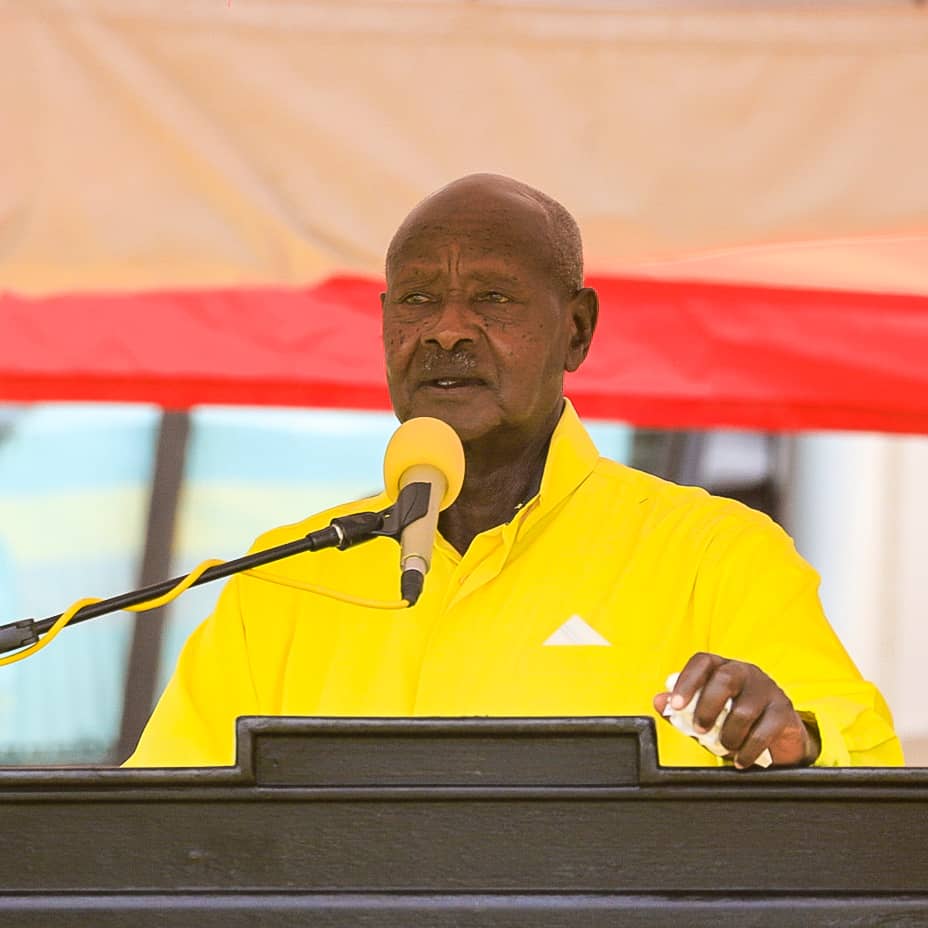

President Yoweri Kaguta Museveni has cited the violent incident involving Butambala County NUP legislator Muwanga Kivumbi in Butambala District as a clear illustration of what he described as a broader, pre-planned strategy by sections of the opposition to attack polling stations in areas where they lost during the January 15, 2026 general elections, warning that the state had full prior knowledge of the plan and the capacity to respond decisively.
Kivumbi lost miserably in the recently concluded elections but at the time refused to concede defeat. According to the Uganda police spokesperson Kituuma Rusoke, the frustrated legislator reportedly ferried panga wielding goons from parts of Nansana and Kampala, ordering them to participate in election violence by attacking police posts and polling stations to seize ballot boxes from polling agents and presiding officers. Kituuma says their efforts were equally frustrated by alert security operatives who arrested over twenty one suspects and also engaged in exchange with some of his supporters. Police confirm that seven people died in the altercation.
Speaking after the elections to NRM leaders in Rwakitura on Sunday, Museveni said intelligence agencies had detected a coordinated plot in which armed gangs were to be deployed to disrupt voting and intimidate officials wherever National Resistance Movement candidates prevailed.
“What these people were planning is what Kivumbi did in Butambala. That was their plan everywhere. The plan was that where NUP is defeated, gangs with the pangas, you remember pangas, should attack the polling station.” he said
President Museveni revealed that the plan materialised in Butambala after Kivumbi was defeated, prompting an immediate and lethal response from security forces deployed to protect the electoral process. The President defended the actions of the security agencies, stating that the government had anticipated the violence and was fully prepared to deal with it.
“In Butambala, when a character called Kivumbi was defeated, they came with the pangas to attack the polling station, and they were shot. Seven of them were shot dead with the pangas. Of course, we were ready to deal with them decisively. I knew their plan.” he said
He added that the Butambala incident was not an isolated case, but part of a wider scheme that ultimately failed in many areas because those recruited to carry out the violence declined to participate.
“Most of the people who were supposed to do that refused and came and met me. They told me the whole story. This is not the first time this has happened.” he added
President Museveni said similar plots had been uncovered before, including during earlier periods of unrest in the region, but were neutralised because those targeted for mobilisation chose not to comply.
“The other year, when there were riots in Kenya, the same riots were supposed to happen here. But the people they wanted to use came and told me, and we refused.” he further stated
He said this pattern demonstrated that many Ugandans resist being drawn into violence, even when encouraged by political actors.
The President distinguished between what he called legitimate opposition and groups he accused of engaging in violent or subversive activities, warning that the latter would not be tolerated. He accused sections of the opposition of collaborating with external actors to destabilise the country.
“Some of the opposition are wrong, but not terrorists. But some of the opposition are wrong and also terrorists. They are working with foreigners, some foreigners, and other groups,” he said.
Issuing what he described as “free advice,” Museveni warned that the state was fully aware of their activities.
“Please stop what you are doing, because we know everything, you will not do it, either peacefully or unpeacefully. We shall maintain peace in Uganda.” he emphasized
Museveni said he has engaged religious leaders in an effort to prevent further violence, citing a meeting with Msgr. Serverus Jjumba the bishop of the Diocese of Masaka, over Fr Sekabira, following his arrest in Masaka.
“When I met Bishop Jjumba here a few days ago, we had arrested a priest Sekabira in Masaka because he was involved with Kyagulanyi. They wanted me to release him, and I said no.” Museveni said.
He said the state would only consider leniency if those involved abandoned what he described as subversive activities.
“You can release him if they tell the truth and if they stop. Because our interest is not to punish. Our interest is that they must stop doing this and never do it again.” Museveni said.
Museveni warned opposition actors against underestimating the character and cultural values of Ugandans, arguing that attempts to incite violence run counter to deeply held societal norms. He invoked historical examples to illustrate resistance to coercion.
“Be very careful with Ugandans. These Ugandans are from very strong cultures and have a very strong sense of fairness. Those young boys refused to do bad things even when they were threatened with death. This is Uganda. People here will refuse to be used.” he said
President Museveni thanked Ugandans for maintaining peace and restraint during and after the elections, including those who were aggrieved by the loss of National Unity Platform presidential candidate Robert Kyagulanyi, saying their decision not to resort to violence demonstrated political maturity and love for country.
“I want to thank the people of Uganda for remaining peaceful, disciplined and patriotic, even those who were unhappy and aggrieved by the outcome of the election, including supporters of Mr Kyagulanyi, because choosing peace over chaos is what safeguards our country and allows us to resolve political differences without destroying the nation,” Museveni said.
He further reiterated that the state remains alert and uncompromising in its commitment to security.
“We were ready then, and we are ready now. Peace will be maintained in Uganda.” he said