



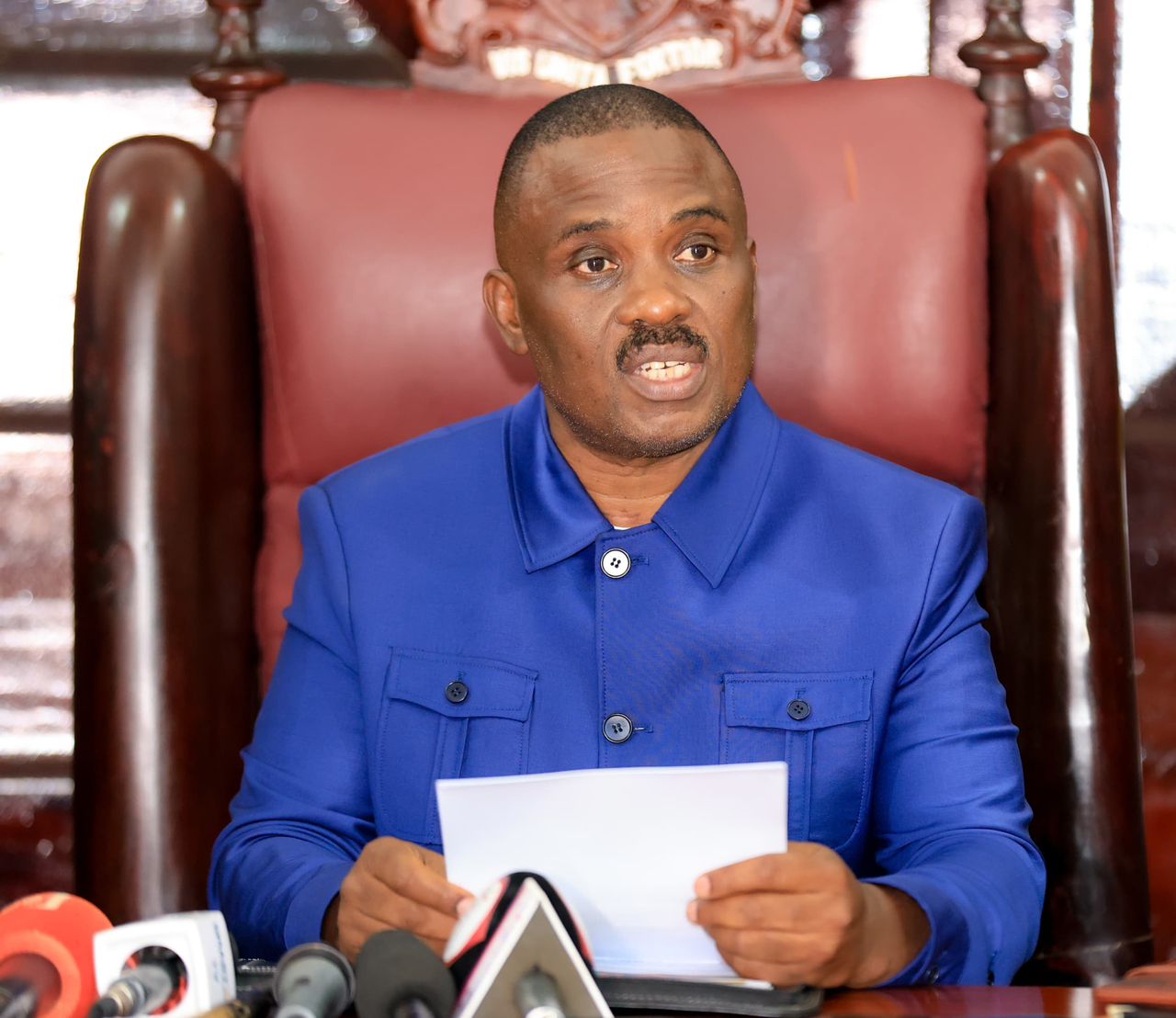

The Politica leadership of the Kampala Capital City Authority (KCCA) headed by the outgoing Lord Mayor, Erias Lukwago has raised serious concerns over the severe reductions in government funding for the 2026–2027 financial year, warning that the budget cuts are likely to stall a wide range of planned development projects, including critical road works, drainage improvements, market construction for urban traders, waste management initiatives, and the upgrading of public health facilities.
Lukwago indicates that the city may be forced to formally escalate the matter to the Speaker of Parliament to seek intervention.
Speaking during a recent briefing on the city budget and strategic plan implementation, Lukwago said that KCCA had adopted a new strategic development plan covering the period 2025 to 2030, which projected that the government would remit a total of Shs 11.9 trillion over five years, equivalent to approximately Shs 2.4 trillion per financial year, in order to support a range of interventions aimed at modernizing the city’s infrastructure and improving services for residents, including the urban poor and informal traders.
“The first year of the implementation of this new strategic plan, which runs from 2025 to 2030, required Shs 2.4 trillion, yet the appropriation to KCCA for the financial year 2025–2026 was only Shs 916 billion, far below the projected amount, and now, as we enter the second year of implementation, covering 2026–2027, where again we were expecting Shs 2.4 trillion, we have instead been allocated just Shs 720 billion, and these figures are wholly insufficient to implement the critical interventions that we had planned,” Lukwago said.
He added that the budget shortfall has left the city executive committee unable to make meaningful allocations, even as time runs short for submitting budget estimates to Cabinet, as mandated by the Prime Minister.
“When we sat in the meeting on Tuesday with the technical team to consider the budget, it turned into nothing more than a lamentation forum, a discussion where we simply lamented the cuts and constraints imposed upon us, and ultimately, we were unable to make any allocations because the figures provided are grossly inadequate to cover the priorities that we had projected under the strategic plan,” he said.
Among the key projects threatened by the shortfall, Lukwago highlighted the construction of two markets in each division of Kampala, a directive intended to cater for the urban poor and informal traders, as well as the completion of the Kitintale Market, which has remained unfinished for years. “Supposedly, we were to construct two markets per city division and complete Kitintale market, yet no funds have been allocated for these purposes, leaving traders uncertain about their livelihoods and depriving thousands of informal entrepreneurs of functional and safe spaces to carry out their businesses,” he noted.
The Lord Mayor also cited critical infrastructure projects, including the improvement of Kampala’s road network, which was designed to reduce travel time across state roads from 4.2 minutes per kilometre to approximately three minutes per kilometre, a key measure aimed at alleviating traffic congestion that plagues the city daily. Additionally, the Kampala Drainage Master Plan, in its final year of implementation, remains underfunded, threatening ongoing efforts to mitigate recurrent floods and the associated damage to property and human life.
Lukwago further emphasized the impact of budget cuts on waste management initiatives, including the decommissioning and repurposing of Kiteezi landfill and the construction of a modern recycling and waste treatment facility at Ddundu, as well as the plan to deploy one garbage truck per parish across all 100 parishes in the city, projects that have all been stalled due to the lack of funding.
He also noted that the implementation of the Kampala Physical Development Plan, which prioritizes high-capacity public transport, equitable wetland restoration, climate resilience, and slum upgrading, has been placed on hold, along with plans for street lighting citywide, upgrading all eight KCCA health centres to hospital status.
In response to these challenges, Lukwago indicated that KCCA may formally communicate the issue to the Speaker of Parliament to draw attention to the disconnect between government projections and actual allocations, stating, “Given the scale of these cuts and the inability to implement these strategic priorities, we shall be writing to the Speaker to formally raise these concerns, so that Parliament is aware of the serious consequences these budget reductions have on the development of Kampala, the welfare of our residents, and the livelihoods of our traders, whose markets remain unfinished and whose businesses continue to suffer.”