



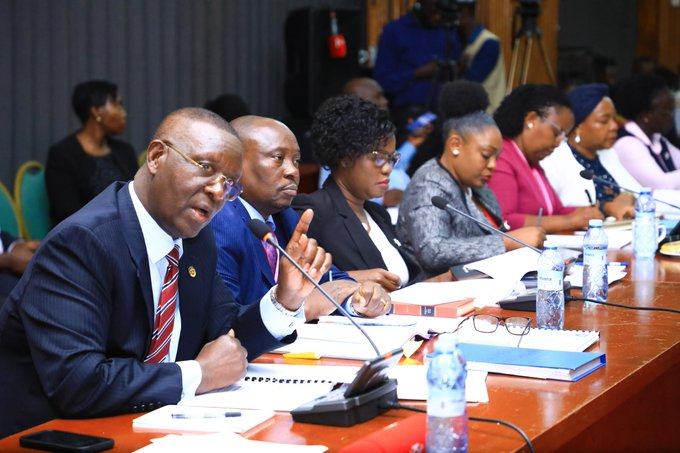

The Judiciary has supported the proposed Magistrates Courts Amendment Bill, 2026, saying the reforms will significantly reduce the heavy case backlog currently faced by the Judiciary of Uganda.
In a written presentation to the Parliament of Uganda Legal and Parliamentary Affairs Committee, Acting Chief Registrar Lamunu Pamella Ocaya said expanding the civil jurisdiction of magistrates’ courts could allow the transfer of thousands of cases currently handled by the High Court.
Lamunu revealed that as of December 2025, the High Court had 70,186 pending cases, including a backlog of 21,317 cases, representing 30.37 percent of the total caseload.
“Of these cases, 34,481 cases (49.13 percent) are eligible for transfer to Magistrates’ Courts, including 11,040 backlog cases (51.79 percent), which would reduce the overall caseload to **35,705 pending cases and 10,277 backlog cases,” Lamunu told the committee.
According to the Judiciary, High Court Circuits account for the largest share of transferable cases, with 29,769 cases (71.22 percent), including 9,578 backlog cases.
High Court Divisions, however, account for a smaller portion of transferable cases, with 4,712 cases (16.60 percent) including 1,462 backlog cases.
The proposed reforms follow the tabling of the Magistrates Courts Amendment Bill, 2026 in Parliament by Norbert Mao on February 27, 2026.
The Bill seeks to amend the law to:
Increase the pecuniary jurisdiction of magistrates’ courts
Enhance powers of magistrates to impose higher fines
Abolish the position of Magistrate Grade II
Provide for the designation of magisterial areas
According to the Ministry of Justice and Constitutional Affairs, the pecuniary jurisdiction of magistrates’ courts was last revised in 2007.
Currently, Chief Magistrates handle civil cases up to UGX50 million, while Magistrates Grade I handle cases up to UGX20 million.
Mao told Parliament that the limits have become outdated due to inflation.
“Due to inflation and changes in the value of money, the capping of the value of the subject matter is very low for the magistrates’ courts and as a result cases that should be handled at the magisterial level end up in the High Court thereby causing backlog,” Mao said.
Under Clause 10 of the Bill, government proposes to increase the jurisdiction of Magistrates from UGX20 million to UGX50 million, while Chief Magistrates’ jurisdiction would rise from UGX50 million to UGX100 million.
However, the Judiciary has proposed further increases.
Lamunu suggested that the jurisdiction of Chief Magistrates be raised to UGX200 million, while that of Magistrates be increased to UGX100 million.
“In Clause 10 of the Bill, I propose that paragraphs (a) and (b) be substituted with the following: Section 206 of the principal Act is amended in subsection (1)(a) by substituting the words ‘fifty million shillings’ with ‘ten thousand currency points’ equivalent to UGX200 million,” she proposed.
She said the proposal would help address inflation and reduce High Court backlog by allowing magistrates’ courts to handle higher-value civil disputes.
Lamunu also suggested that the power to revise pecuniary jurisdiction should be given to the Minister of Justice through statutory instruments rather than requiring parliamentary amendments each time.
“To empower the Minister of Justice by statutory instrument to vary the pecuniary jurisdiction where it becomes necessary. This will reduce the lengthy legislative process,” she said.