



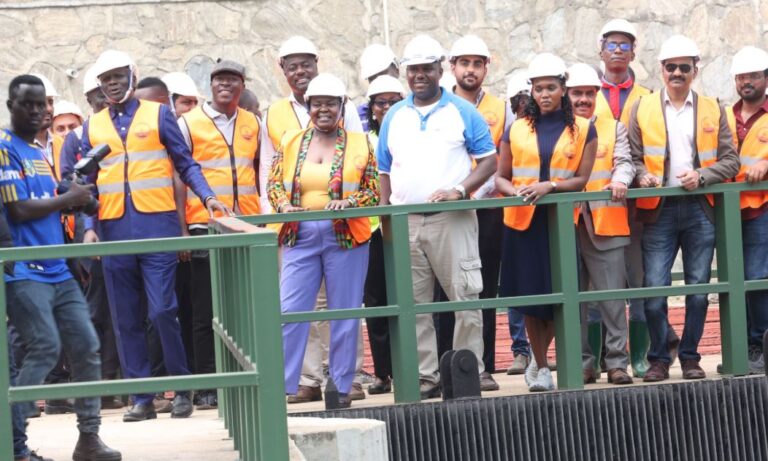

Uganda’s ambitious industrialisation agenda, particularly in the long-underserved West Nile sub-region, received a massive boost on Friday with the official commissioning of the USD 20 million Nyagak III Hydropower Plant.
With a generation capacity of 6.6 megawatts (MW), this Public-Private Partnership (PPP) project is set to address chronic power shortages, dramatically improving electricity access and reliability and unlocking new avenues for economic development in a region historically plagued by energy deficits.
The commissioning ceremony was graced by the Minister of Energy and Mineral Development, Hon. Dr. Ruth Nankabirwa Sentamu, flanked by the State Minister for Energy and Mineral Resources, Hon. Phiona Nyamutoro.
“For so long, there have been concerns about the poor quality of power supply and the inability to meet the sub-region’s demand,” Minister Nankabirwa stated.
“The Nyagak III project offers one of the lowest tariffs among Uganda’s hydropower plants, delivering a wide range of benefits for the West Nile region and significantly enhancing Uganda’s electricity supply,” she added.
Powering Industrial Growth in West Nile
The West Nile sub-region, with its significant agricultural potential, growing urban centres like Arua City, and strategic border location, has long awaited a stable and affordable power supply to fuel its industrial aspirations.
Before 2024, the region relied on an isolated grid, primarily served by the 3.5 MW Nyagak I and a 1.5 MW thermal plant, resulting in persistent power rationing and high costs.
The connection of West Nile to the national grid in 2024, followed by the commissioning of Nyagak III, brings the region’s total reliable generation capacity to 9.9 MW. This increase in capacity and reliability is expected to be a game-changer for industrialisation.
Reliable electricity is recognised as the “backbone of modern economies” and a key driver for socio-economic transformation. For West Nile, Nyagak III will enable the following:
Attract New Investments
Investors, both local and foreign, are often deterred by unreliable and expensive power. The availability of consistent, affordable electricity at one of Uganda’s lowest tariffs (US Cents 5 per kWh for Nyagak III, compared to up to US Cents 10 for other projects) significantly reduces operating costs for businesses, making the region an attractive hub for industrial ventures.
This is crucial for Uganda’s overall industrialisation agenda, which aims to shift the economy from subsistence farming to value-added manufacturing.
Boost Manufacturing and Agro-processing
West Nile is predominantly agricultural, with key crops like beans, cassava, maize, and simsim. However, much of this produce undergoes minimal processing. Nyagak III provides the necessary energy for establishing and expanding agro-processing factories, for instance, for milling maize, processing simsim oil, or creating value-added products from cassava.
In the long run, this will reduce post-harvest losses, increase farmer incomes, and create jobs in the manufacturing sector.
Expand Existing Businesses
Current businesses, often relying on expensive and polluting diesel generators to cope with power outages, can now operate more efficiently and cost-effectively. This will enable them to increase production, improve product quality, and potentially expand their operations, creating more employment opportunities.
Support Urbanisation and Services
Reliable power strengthens urban centres like Arua City, contributing to the growth of service industries, commercial enterprises, and modern infrastructure essential for supporting an industrialising economy. It improves the quality of life, which in turn attracts and retains skilled labour.
Job Creation and Skill Development
As Minister Nankabirwa highlighted, Nyagak III will deliver reliable power, new jobs, skills, and rural development for the people of West Nile. The construction phase itself created jobs and transferred skills, and the subsequent industrial growth will multiply these benefits, driving down unemployment.
Symbol of Sustainable Development
The Nyagak III project, developed under a Public-Private Partnership (PPP) involving Uganda Electricity Generation Company Limited (UEGCL), Hydromax Limited, and DOTT Services Limited (through their SPV, Genmax Nyagak Ltd), faced significant hurdles, including funding withdrawals, the COVID-19 pandemic, and geological challenges.
Its successful commissioning therefore stands as a “symbol of resilience and collaboration,” as Minister Nankabirwa noted, reaffirming Uganda’s commitment to building a brighter and more sustainable energy future.
Nankabirwa noted that this clean energy facility also directly contributes to Uganda’s commitment to Sustainable Development Goal 7, which is ensuring access to affordable, reliable, sustainable, and modern energy for all.
By addressing power challenges, Nyagak III is not just a power plant; it is a driver for economic transformation, set to ignite industrialisation and improve the livelihoods of millions in the West Nile sub-region and beyond.