



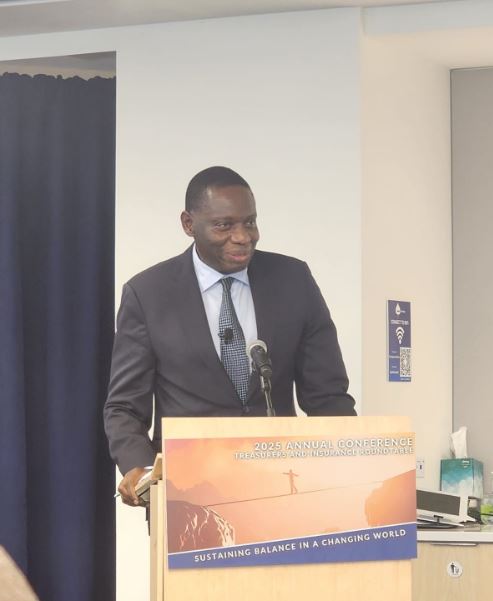

The Bank of Uganda (BoU), under the leadership of Governor Dr. Michael Atingi-Ego, early this week participated in the Treasurers and Insurance Roundtable held in Washington, D.C., USA a pivotal global convening that brought together leading practitioners from the humanitarian and development aid sectors, top-tier financial institutions, and emerging fintech solution providers.
Held under the theme “Sustaining Balance in a Changing World,” this year’s roundtable spotlighted the evolving challenges and strategic opportunities facing International Non-Governmental Organisations (INGOs) amid global uncertainty. From geopolitical tensions to digital disruption, the forum examined the forces reshaping how aid flows, how risks are managed, and how innovation can sustain missions in fragile contexts.
A key discussion point was the impact of geopolitical risks on INGO operations. The roundtable noted that conflicts, shifting alliances, and sanctions not only impede aid delivery and access to vulnerable communities but also elevate operational costs and personnel risks. Strategies to insulate INGOs from these shocks, including agile financial systems and stronger regulatory coordination, were explored in depth.
Beyond geopolitics, participants examined the internal pressures INGOs face, including donor fatigue, stricter compliance demands, and the shrinking civic space in some regions. Despite these headwinds, optimism emerged from growing regional collaborations, enhanced digital infrastructure, and the promise of fintech partnerships to streamline funding and increase impact.
One of the most transformative areas of focus was the emergence of fintech in cross-border operations. INGOs are increasingly exploring digital tools to reduce costs, accelerate disbursements, and ensure traceability.
While emphasising the importance of fintech in transforming lives, Dr. Atingi-Ego has often noted that; “Through digital innovations, we are bringing financial services closer to underserved populations. A stable currency, efficient payment systems, and regulatory clarity are essential for fostering development finance.” This is the exact message he reiterated in Washington.
He further highlighted how machine learning, blockchain, and real-time payment systems are redefining how funds flow globally, improving not just speed but also security and compliance. He pointed out that Uganda is not just talking about fintech transformation but executing it.
The Governor revealed that earlier this year, BoU initiated a major upgrade of its Real-Time Gross Settlement (RTGS) system in partnership with Swedish fintech firm CMA Small Systems.
This upgrade, according to Dr. Atingi-Ego, introduces real-time, multi-currency settlements, ISO 20022 messaging standards for cross-border compatibility, enhanced fraud monitoring and liquidity tools, plus integration capabilities with regional and global payment platforms.
This modernization, Antingi-Ego noted, is a clear signal that Uganda is aligning its financial infrastructure with global fintech trends, ensuring faster, safer, and more accountable fund transfers, particularly beneficial for INGOs and humanitarian agencies operating in the country.
In addition, he revealed that BoU recently licensed fintech platforms like NALA, enabling instant, mobile wallet-based remittances from the diaspora directly into Uganda.
This step reduces transaction fees and empowers families and communities with more efficient financial flows, demonstrating regulatory support for innovation without compromising oversight.
Dr. Atingi-Ego’s participation underscored Uganda’s growing stature as a voice of stability and innovation in global financial forums.
Under his leadership, Uganda has maintained low and stable inflation, stabilised the Uganda Shilling, expanded financial inclusion through mobile money and agency banking, and taken a proactive stance on fraud mitigation and cybersecurity.
“Uncertainties from global developments, geopolitics, extreme weather, strong U.S. dollar, could cause inflation to rise faster and disrupt economic activity. This situation necessitates a cautious approach to monetary policy,” the Governor has often said during BoU briefings.
Such caution and foresight, which he reiterated at the Roundtable in Washington, have allowed Uganda to weather global shocks and continue its path toward sustainable economic development.
The BoU’s visible presence and leadership at this high-profile international roundtable signal more than diplomatic participation; they reflect Uganda’s strategic intent to shape the future of development finance.
Dr. Atingi-Ego’s keynote address and Uganda’s demonstrated fintech reforms show that the country is not only resilient in the face of global instability but also ready to partner, lead, and innovate in support of global humanitarian and financial inclusion efforts.
With proactive policies, modern infrastructure, and forward-looking leadership, Uganda continues to position itself as a reliable and forward-thinking partner on the global development stage.