





The country woke up this morning to breathless headlines and hyperactive social media feeds celebrating Bobi Wine’s dramatic welcome in Arua on 19th November 2025. Photos were everywhere people standing on rooftops, hanging on bodabodas, climbing trees, and squeezing themselves onto any available surface like fans waiting for a music festival to begin. Uganda loves a good picture, and Arua delivered one. The media buzzed, commentators clapped, and keyboard warriors declared it the “proof” they had been waiting for: that Arua is Bobi Wine’s unshakable stronghold. But then reality, as always, arrived with a calculator.
Because if Arua is indeed the mighty fortress that the photos claim it is, if Bobi Wine is as strong there as people loudly portray, one question becomes unavoidable: how did NUP manage to field only fifteen candidates in the entire West Nile region? 15 candidates out of 39 constituencies. That is not a stronghold. That is not even a moderate hold. That is a hopeful grip on a slippery rock. It is the kind of number that forces us to consider whether the large turnout in Arua was the electrifying reception of a presidential candidate or simply the nostalgic excitement of people seeing their favorite musician back on stage after a long break.
In fact, the numbers make it embarrassingly clear. When you have tens of thousands cheering for you on one day, but only 15 people willing to stand under your party ticket across the whole region, it becomes difficult to argue that the crowd represents political momentum. It begins to look more like entertainment, something akin to a thrilling “one-off victory” the kind politicians hold onto the same way gamblers hold onto the one time they won ten thousand shillings. It feels good, it gives you stories, but it doesn’t change the reality of the game.
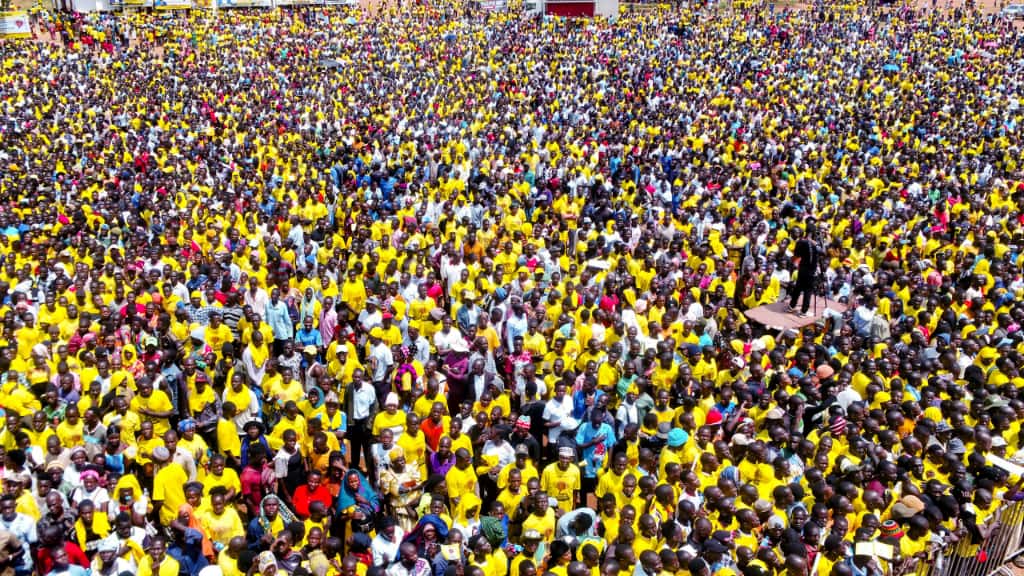
Arua has always had a soft spot for Bobi Wine as a Musician. It motivates him, lifts him, and reminds him that somewhere in Uganda, a crowd can still scream loud enough for him to hear himself think. And that is perfectly fine. Every public figure needs a morale boost. But let us not confuse a moment of excitement with a map of influence. Meanwhile, President Museveni experiences crowds of the same, and often bigger, magnitude across every region he enters. The only difference is that Museveni’s crowds no longer make headlines simply because the country has become used to them. It is like reporting that the sun has risen predictable, consistent, unquestioned.
And that is precisely why his massive turnouts are not treated as breaking news. Museveni’s support is not episodic. It is not driven by novelty, hype, or sudden electricity. It is a stable, continuous wave of genuine trust built over decades, reinforced by a development record that is visible in every region. From the roads that now connect Karamoja to major trade routes, to the improvements in health infrastructure, education, peace, and rural transformation these are not theories. They are lived experiences. Museveni’s crowds do not gather because he is a performer; they gather because he has delivered stability and progress that people can measure with their own lives.
Which brings us back to the West Nile spectacle. If the region truly belonged to Bobi Wine in the way the photos suggest, the simplest evidence would be candidates not selfies. Fielding only fifteen candidates in a region with 39 constituencies is a serious red flag for any party claiming grassroots strength. It is impossible to argue that you are a regional powerhouse when ninety percent of your ballot slots are empty. And so the logical conclusion, though uncomfortable for some, is the most straightforward: the people of Arua came to see the entertainer, not the alternative president.
There is a difference between a crowd that comes to cheer and a crowd that comes to choose. Bobi Wine received the first. Museveni continues to receive the second. And as Uganda moves closer to 2026, it becomes increasingly clear that enthusiasm is not the same as electoral infrastructure. Applause is not the same as a political machine. And hype, no matter how loud, cannot replace a national mandate.
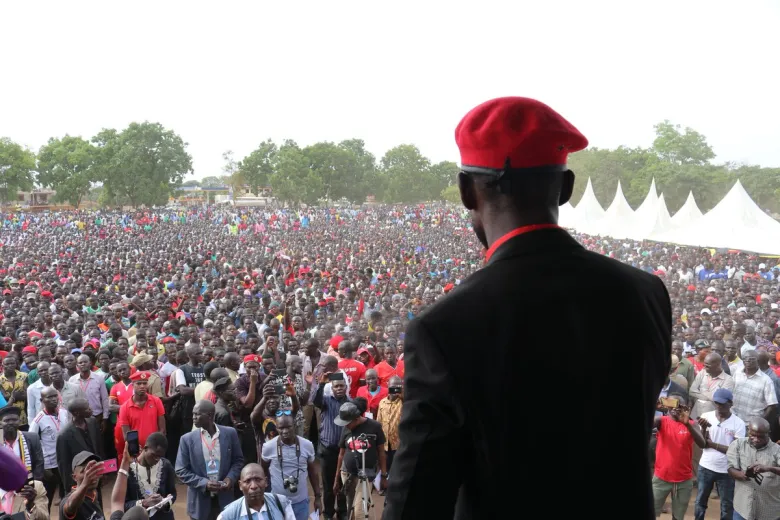
Arua had its moment. Bobi Wine had his excitement. The photos trended. The hashtags flew. But in the quiet world of actual numbers, Uganda has already spoken. And the message remains unchanged: Museveni continues to command the widest, most consistent, most politically grounded support across the country. While others celebrate flashes of excitement, Museveni moves with the steady confidence of a leader whose momentum does not appear once in a while but every day, everywhere.
Because when the noise fades, and the cameras go home, and the crowds disperse, counting begins. And numbers, unlike social media emotions, do not lie.