



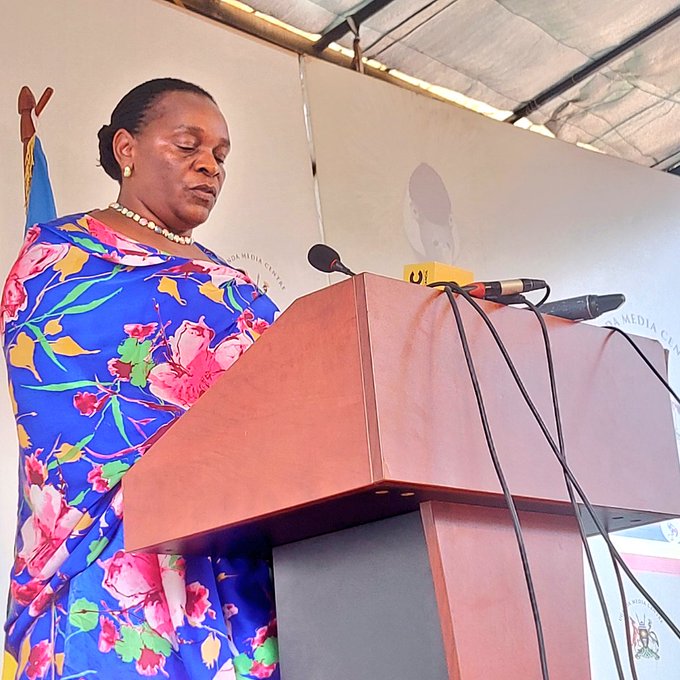

The Government of Uganda has called for increased investment in justice systems to improve access to justice for women and girls as the country prepares to commemorate International Women’s Day 2026.
Speaking at the Uganda Media Centre in Kampala, the State Minister for Culture, Peace Mutuuzo, said this year’s celebrations will be held on 8 March 2026 at Kololo Ceremonial Grounds.
Mutuuzo said the annual event is an opportunity to reflect on the status of women and renew commitment toward addressing persistent inequalities affecting women and girls.
“International Women’s Day is a globally recognised moment to reflect on the status of women, celebrate the progress made, and most importantly renew commitment to addressing persistent inequalities that affect women and girls,” Mutuuzo said.
She noted that although women remain central to Uganda’s social, economic, and cultural development, they continue to face significant barriers in accessing justice, opportunities, and protection.
The minister said the national theme for this year’s commemoration is “Scaling up Investments to Accelerate Access to Justice for all Women and Girls in Uganda.”
According to Mutuuzo, access to justice plays a critical role in protecting women from abuse and discrimination.
“Access to justice is not an abstract concept. It determines whether a survivor of gender-based violence is protected or silenced, whether a widow retains her land or is dispossessed, whether a girl remains in school or is forced into early marriage, and whether women can claim their economic and social rights without fear or discrimination,” she said.
She stressed that justice is fundamental to equality, development, and social cohesion in society.
The minister also raised concern over the growing backlog of gender-based violence cases in the courts.
According to data from the Judiciary’s court census report, gender-based violence cases account for about 32 percent of the total case backlog in Uganda.
She revealed that 3,636 of the cases involve defilement, while aggravated defilement accounts for nearly 29 percent of the backlog.
Mutuuzo added that the High Court currently has 4,888 pending cases, with 1,818 of them remaining unresolved for more than two years.
“At the Chief Magistrate’s level, there are 4,816 gender-based violence cases, with 865 classified as backlog. As the saying goes, justice delayed is justice denied,” she said.
The minister explained that several barriers continue to prevent women from accessing justice, including economic hardship, long distances to courts, limited legal awareness, and lack of adequate witness protection mechanisms.
She said these challenges often force women to rely on informal community mechanisms which are frequently influenced by patriarchal attitudes.
“These systems are often characterised by patriarchal biases and unequal power dynamics that limit women’s ability to obtain justice and encourage impunity,” she said.
Despite the challenges, Mutuuzo said Uganda has made significant progress in advancing women’s participation in leadership, education, and economic activities.
She revealed that government has financed 21,948 women group enterprises, benefiting 235,114 women under the Uganda Women Entrepreneurship Programme (UWEP).
She also said that during the 2025 financial year, government funded 24,228 youth enterprises worth Shs191.3 billion, benefiting 271,211 young people, at least 30 percent of whom are female.
In addition, women currently make up 34.5 percent of Members of Parliament, while 40 percent of Cabinet ministers are women.
At the local government level, women account for 45.7 percent of leadership positions.
Mutuuzo added that programmes such as Universal Primary Education (UPE) and Universal Secondary Education (USE) have significantly improved girls’ access to education.
The minister said government has also strengthened justice institutions to improve protection for women and girls.
These include Gender and Children Desks within the Uganda Police Force, specialised gender prosecution units within the Office of the Director of Public Prosecutions, and family courts that use gender-sensitive and child-friendly procedures.
Government has also introduced reforms aimed at reducing case backlog through alternative dispute resolution mechanisms, electronic case management systems, and virtual court sessions.
She said these initiatives are designed to improve efficiency and ensure timely justice for victims.
Mutuuzo emphasised that achieving justice for women requires collective effort from government institutions, civil society, cultural leaders, religious institutions, and communities.
“Harmful social norms must be confronted. Silence and stigma must be broken. Survivors must be supported and not blamed,” she said.
She urged Ugandans to actively participate in the upcoming celebrations.
The minister also confirmed that President Yoweri Kaguta Museveni will be the chief guest at the national celebrations.
Mutuuzo invited women’s organisations, youth groups, development partners, and the media to participate in the event.
“As we commemorate International Women’s Day, let us reaffirm our shared responsibility to protect the rights of women and girls and ensure justice systems serve those most in need,” she said.