



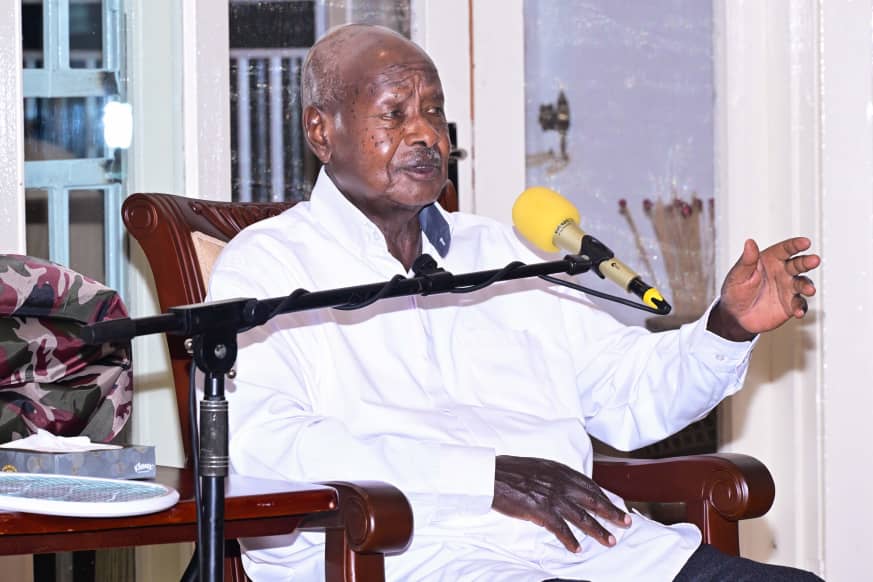

President Yoweri Museveni has defended the Parish Development Model (PDM) as a strategic framework designed to reduce poverty and ensure inclusive wealth distribution across Uganda.
The President notes that the programme’s role lies in reaching citizens who have historically been excluded from the benefits of national production, even as overall output continues to grow under NRM policies.
In his post-election address, President Museveni noted that while national production had increased substantially over the years, millions of Ugandans remained trapped in subsistence farming, working only for survival and largely excluded from the economic gains of growth, and he stressed the importance of PDM in addressing this persistent challenge.
President Museveni traced the evolution of government programmes from NAADS, Operation Wealth Creation (OWC), Youth and Women Funds, to the present PDM, acknowledging that while previous initiatives had achieved notable successes, they had also revealed structural limitations, particularly in the equitable distribution of benefits.
“By 2019, prosperity was covering 61% of the homesteads of Uganda. 39% were still among the Abakolera ekidda Kyoonka, working only for the stomach subsistence production. The PDM is designed to lift this 39% into meaningful participation in the economy. All the previous programmes like Entandikwa, NAADS, OWC, Youth Fund, Women Fund, Emyooga had done well, but the distribution was always captured by state agents or elites. PDM empowers ordinary citizens and ensures that everyone has a chance.” he noted
He further explained that widespread elite capture of government resources necessitated the introduction of PDM, which complements previous programmes by empowering ordinary citizens directly, rather than relying solely on state agents or local officials.
“Indeed, I started hearing my people saying: ‘Begabila bokka’, ‘they only give to their friends or relatives’. That is when I insisted on PDM. In all the previous Govt efforts, it was the state agents, LC3 Chairperson for Entandikwa, Agricultural officers for NAADS, Army Officers for OWC that were doing the kugaba (to distribute). My political and pro-mass radar told me that if the people in the Parish could form a mass SACCO of all the adults in the Parish and elect their own committee that would prioritize the list of the recipients, it would be much better. Where it has been done well, the People are very happy.”he explained
President Museveni provided detailed data on national agricultural and livestock production as evidence of NRM policies’ effectiveness in increasing outputs across key sectors, citing figures that demonstrate remarkable growth since the late 1980s, but insisting that this growth must benefit all citizens, not only the elite.
“Coffee at 9 million bags from 3 million in 1986. Milk 5.3 billion litres instead of 200 million litres in 1986. Maize 5 million tonnes instead of 500,000 tonnes in 1986. Cattle 16 million heads, instead of 3 million in 1986. Bananas 12 million tonnes instead of 6 million tonnes. Cassava 5 million tonnes instead of 1.9 million tonnes in 1986. We are now at 49.6 million trays of eggs.”he noted
He further revealed the historical context, showing that at independence, the majority of Ugandans were excluded from the money economy, remaining subsistence farmers, and noted that PDM is intended to give these citizens a tangible stake in economic development: “At independence, the people in the money economy were only 9%, the Abakolera ekidda kyoonka were 91%. As a witness of independence, I can confirm that in areas like Ntungamo, Kashaari and Bukanga, the Abakolera ekidda kyoonka were 99%.” he said
Explaining the operational design of the PDM, Museveni detailed how the formation of parish-wide SACCOs ensures transparent and fair distribution of resources, enabling ordinary citizens to determine beneficiaries directly: “If the people in the Parish form a mass SACCO of all adults, they elect their own committee. This committee prioritizes who receives funds and benefits. This is better than relying on LC3 Chairpersons, agricultural officers or Army Officers to distribute resources because it ensures fairness and transparency.”
President Museveni also noted that the PDM has helped build trust between citizens and government structures, creating a positive political atmosphere, particularly in areas that previously experienced marginalization.
“With the North, the North-West and Karamoja, it is peace (Kuc), infrastructure (tarmac roads, water, schools, health centres, etc.) and PDM. The People are tired of the negativity of the old mistake-makers who try to eclipse the contribution of the NRM to the area with endless gobas (lies).” he said
He linked the success of PDM and inclusive economic participation to the positive reception he observed during campaign engagements, highlighting how the model strengthens citizen confidence in government initiatives: “This has been one of the factors that has created the good atmosphere I saw on the campaign trail.”
ThePresident Museveni reiterated that every adult in a parish participates in the SACCO, which elects a committee responsible for determining beneficiaries, ensuring a participatory, transparent, and equitable approach to development and the distribution of government resources: “Every adult in the parish participates in a SACCO, which elects a committee to decide beneficiaries of development funds.”
The Parish Development Model (PDM) is Uganda’s flagship socio‑economic transformation strategy, designed to lift the poorest households out of subsistence living into the money economy by using the parish as the primary hub for planning, budgeting, and service delivery. It integrates multiple sectors agriculture, financial inclusion, infrastructure, social services, governance and community mobilisation to ensure grassroots economic empowerment.
The PDM was launched in February 2022 by President Museveni, under Uganda’s National Development Plan (NDP) III framework, as a structured approach to address poverty and low incomes among households traditionally outside the money economy.
The central aim of PDM is to transform approximately 39% of Ugandan households that remain in the subsistence economy an estimated around 16 million people into active participants in the money economy through enterprise development, savings and credit, production, value addition and market linkages at the parish level.
Each parish SACCO (Savings and Credit Cooperative Organisation) receives a standard UGX 100 million per year, released in two instalments of UGX 50 million, intended to capitalise parish revolving funds for lending to households. The funds are meant to support about 100 households per parish each year with productive loans (UGX 1 million per household), which are expected to be repaid and recycled, growing the parish revolving fund over time.
Government budgetary commitments have run into trillions of shillings: By November 2025, total transfers to parishes exceeded UGX 3.216 trillion. Parliament appropriated over UGX 1 trillion for the 2022/23 financial year, mainly for parish revolving funds.
According to government data and implementation tracking, by late 2025, an estimated 3.27 million Ugandans were reached directly with PDM funds through repayment and lending cycles. Data from the 2024 National Population and Housing Census suggested that PDM had reached 832,746 households by FY2024/25 under parish planning activities. In some districts like Kanungu, local reports show 10,587 households benefiting from revolving funds by the end of 2023.Other local governments like Kabarole reported thousands of individual beneficiaries engaged in agriculture, trade and other income‑generating activities.
A digital Parish Development Model Information System (PDMIS) has collected data on over 8 million households to track beneficiaries, enterprise types, loans and repayments, supporting transparency and accountability.In urban settings like Kampala City, more than 28,000 households had received loans by mid‑2025, with parishes cumulatively getting over UGX 29.3 billion in revolving funds.
President Museveni embarked on nationwide PDM performance assessment tours, where he consistently highlighted success stories of households transitioning from subsistence to commercial agriculture and enterprise. Urged leaders to document and compile data on beneficiaries to ensure the programme’s reach and impact could be accurately tracked. Emphasised the inclusion of all adults in a parish in the SACCOs, with elected committees prioritising real beneficiaries for loans. Noted that the structured approach to development at the parish level fosters trust between government and citizens and drives grassroots economic participation.
President Museveni has publicly pledged enhancements to the PDM funding framework, especially for urban and densely populated parishes. He acknowledged that the uniform UGX 100 million per parish allocation may be insufficient in towns and cities with more households, and promised to increase funding allocations for such parishes to reflect actual demand.
In urban settings, he called for household censuses so that funding could be more equitable and responsive to actual population and parish needs.
A government audit found that while UGX 3.26 trillion had been released to SACCOs, only about 84% had reached intended households, with some funds undistributed or unaccounted for, and issues including ghost projects, duplicate lending and weak recovery mechanisms.