



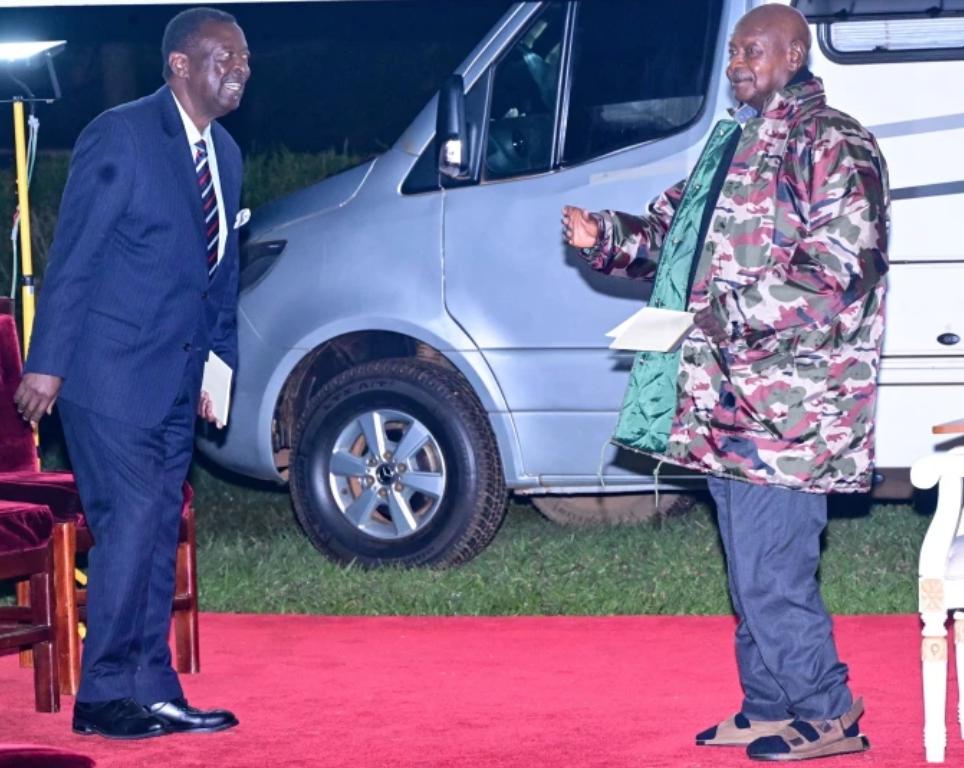

President Yoweri Kaguta Museveni has reaffirmed Uganda’s steady progress in meeting the country’s seven key socio-economic transformation objectives—peace, development, wealth creation, job creation, expanded markets, regional integration, and strategic security.
Speaking during a media engagement with journalists from the Busoga Sub-region at the Mayuge District State Lodge, President Museveni highlighted the rapid growth of the service sector and the strong governance systems that have safeguarded fundamental freedoms, including the widespread enjoyment of free speech.
The President underscored the critical importance of a consolidated East African regional market, describing it as essential for building a robust and competitive economic bloc. However, he cautioned that Africa’s persistent fragmentation poses serious risks to the continent’s survival, especially in the absence of a unified and reliable security framework.
On environmental and land-use concerns, President Museveni addressed the ongoing dispute over the Mayuge forest land involving the National Forestry Authority and local communities. He also called for harmonized and productive use of wetlands across the Busoga Sub-region, urging residents to refrain from misusing or underutilizing these vital natural resources.
He explained that rice cultivation in wetlands provides lower economic returns compared to fish farming, which can be further enhanced by irrigation systems to support other agricultural ventures. The President emphasized both the economic and environmental importance of conserving wetlands.
Turning to infrastructure development, President Museveni instructed NRM Secretary General Richard Todwong to follow up on the compensation process for individuals affected by the construction of the Standard Gauge Railway in districts across the Busoga Sub-region.
On wealth creation, the President encouraged local communities to adopt commercially viable agricultural enterprises capable of driving real socio-economic transformation. He cited successful examples nationwide, including intensive coffee farming in Masaka, palm oil production in Kalangala and Bundibugyo, and dairy farming in cattle-corridor districts.
President Museveni reiterated that the NRM’s wealth-creation message has been consistent and effective since the 1960s, and was formally reinforced in the 1996 NRM Manifesto as a guiding framework for prosperity for all.