



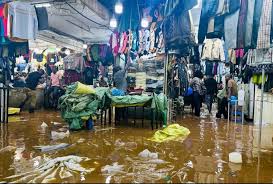

Prime Minister Robinah Nabbanja is today meeting and touring flood-affected areas in downtown Kampala to assess the scale of destruction caused by the recent heavy rains that submerged roads, arcades, and markets. The visit follows a crisis meeting held yesterday between the Kampala Capital City Authority (KCCA) leadership and traders whose businesses were devastated by the flooding.
The floods, which hit Nakivubo Channel, Kisenyi, Katwe, Owino Market, and surrounding arcades, brought transport and business to a standstill, leaving hundreds of traders counting losses worth billions of shillings. Eyewitnesses described scenes of chaos as vehicles stalled, merchandise floated in muddy water, and desperate vendors attempted to save goods from basement shops.
The emergency meeting at City Hall, chaired by Lord Mayor Erias Lukwago and attended by KCCA Executive Director Sharifa Buzeki, Resident City Commissioner Hajji Umaru Mawiya, and technical officials, resolved to form a multi-sectoral technical committee to assess the damage and recommend compensation for affected traders.
Each affected arcade or business complex will nominate two representatives to work with KCCA officials in compiling verified lists of victims and losses. The committee, according to officials, will also examine the impact of the Nakivubo Channel redevelopment project, which many blame for worsening the floods.
“We cannot call this a natural disaster. This is a man-made catastrophe caused by reckless construction that has narrowed the drainage channel and blocked natural water flow. People’s livelihoods have been destroyed because of poor planning.” Lukwago told the meeting.
The Department of Gender and Community Services at KCCA was tasked with compiling trader profiles for financial support and coordinating with national relief offices under the Office of the Prime Minister (OPM).
KCCA Executive Director Sharifa Buzeki assured the traders that the Authority was committed to restoring normalcy. “We are working around the clock to clear blocked drains, de-silt the Nakivubo Channel, and put in place a recovery plan. Government has already directed that all ongoing drainage projects be reviewed to prevent further flooding,” she said.
As part of government’s coordinated response, Prime Minister Robinah Nabbanja is expected to visit the most affected areas, including Nakivubo, Owino Market, Kisenyi, Katwe, and Nabukeera Arcade, to inspect the extent of the damage and engage with traders directly.
Nabbanja will be accompanied by KCCA engineers, disaster response officers, and local leaders to evaluate structural weaknesses, drainage blockages, and progress on de-silting works. Her findings will inform a cabinet brief on urban flood preparedness and compensation mechanisms for affected businesses.
Much of the anger has been directed at the ongoing Nakivubo Channel redevelopment project, led by businessman Hamis Kiggundu (Ham) and his company Ham Enterprises, which aims to convert the open drainage trench into a modern covered “smart channel” integrated with commercial structures.
However, critics, including Lukwago and the Kampala Traders Associations (KACITA, KATA, and UNATA), accuse the developers of narrowing the channel, diverting natural flow, and operating without valid environmental or planning approvals from NEMA and KCCA.
Following last week’s deluge, traders filed a lawsuit at the High Court against Ham Enterprises, KCCA, and NEMA, demanding an injunction to halt construction and compensation for destroyed goods. Lawyer Kasule Mpologoma, representing the traders, described the flooding as “avoidable and unlawful.”
Meanwhile, KCCA has deployed engineers and drainage teams to clear debris and restore flow, while police continue to secure affected zones to prevent looting.