



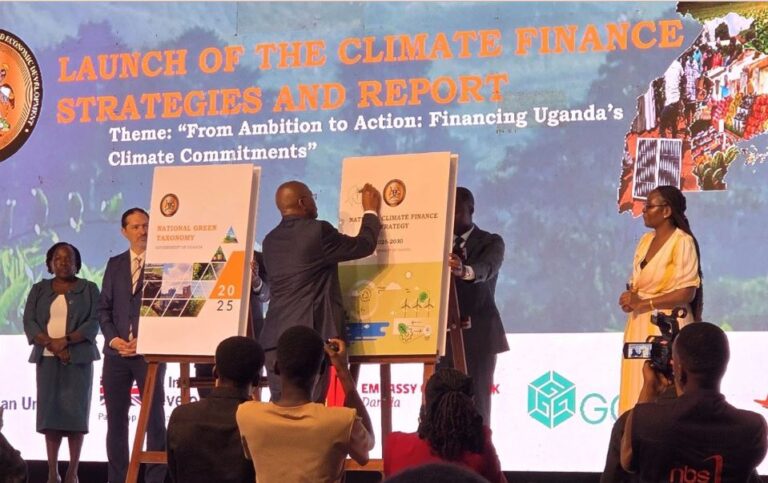

Uganda has taken a significant stride toward aligning its economic ambitions with global climate goals. The Ministry of Finance, Planning and Economic Development, in a landmark partnership with the World Bank, European Union, Stanbic Bank, and other key international and local partners, has launched five strategic frameworks aimed at driving Green Growth across the nation.
According to Cathy Adengo, the Head of Sustainability at Stanbic Bank, this collaborative effort seeks to create a clear and predictable environment for financial institutions to invest in green projects, ultimately mobilising the capital needed to fuel a sustainable future.
Adengo revealed that the frameworks unveiled include the National Climate Finance Strategy, the National Green Taxonomy, the National Climate Finance Vehicle, the Country Climate Development Report, and the Guidelines for Mainstreaming Climate Action in Uganda’s Financial Sector.
These documents, she noted, are designed to provide the financial sector with a robust blueprint for fully participating in climate finance. “They represent a powerful signal that Uganda is committed to achieving its national development goals and NDCs (Nationally Determined Contributions) by embracing a greener, more resilient economic model,” Adengo noted.
As a key partner in the launch, Stanbic Bank Uganda affirmed its commitment to supporting the effective implementation of these frameworks. Adengo reiterated that the bank is set to be a key player in mobilising climate finance for green businesses.
However, it is essential to note that Stanbic’s contribution extends far beyond a policy-level commitment. The bank is a tangible force for Uganda’s economic growth at the grassroots level through its specialised initiatives.
Through the Stanbic Bank Business Incubator and the WYF (Women, Youth, and Farmers) agenda, the bank is actively tackling the foundational issues that often hinder economic empowerment. The Business Incubator has provided hands-on training and mentorship to thousands of entrepreneurs, equipping them with vital skills in financial literacy, market access, and business management.
This support, which echoes Stanbic Bank’s main agenda, ‘Uganda is our home, we drive her growth’, has helped to formalise and grow businesses, enabling them to access significant credit and create thousands of jobs. The WYF initiative, in particular, is a direct investment in the most critical demographics of Uganda’s economy.
According to Kenneth Agutamba, the Stanbic Bank Country Manager for Reputation and Corporate Communication, the bank has committed up to Shs1 trillion to empower these groups with affordable credit and capacity building. By targeting women, who drive a significant portion of entrepreneurship but are often underfunded, and empowering youth and farmers, Stanbic Bank is ensuring that the benefits of green growth are inclusive.
As Adengo noted, these on-the-ground efforts are building a foundation of resilient, skilled, and bankable entrepreneurs who are perfectly positioned to leverage the new green frameworks and drive sustainable change from the ground up.
The launch of these five frameworks, backed by a consortium of global and local partners, marks a pivotal moment in Uganda’s development journey. It represents a powerful fusion of high-level policy with grassroots action.
With the government and its partners paving the way and institutions like Stanbic Bank building the capacity to walk that path, Uganda is not just preparing for a green transition; it is actively building one, ensuring that economic growth is both sustainable and shared.